The Anthrax Graves Under Princeville’s Woods Course
In 1917, anthrax swept the Princeville Ranch and killed hundreds of cattle. A Hawaiʻi court has found that there are anthrax burial sites on the Woods Course, open space surrounded by homes. Left undisturbed, the experts agree, they are safest right where they are. The danger is digging.
The Woods Course today. Photo: Ema Schulz.
“We CANNOT say it isn’t there.”
Dr. Jason Blackburn, the University of Florida scientist who led Starwood’s soil testing on the Woods, in an email to Starwood’s expert. His testing was funded by Starwood’s golf company: $400,880, according to a University of Florida grant record. Starwood did not call him to testify, and the court found its experts’ final report “not credible.” (Trial Exhibit P-206, quoted in the court’s Findings ¶¶124, 126)
Is it safe to live near the Woods?
Left alone, the experts say yes. People have lived and played golf beside these burial sites for decades. The risk comes from disturbing the ground.
Sweden’s national veterinary institute, which has mapped more than 3,000 farms once quarantined for anthrax, says the ground above an undisturbed grave is not dangerous to people or animals, and that if you know exactly where a grave is, you should avoid digging there.
At the Princeville trial, the homeowners’ three anthrax experts agreed that the best way to ensure safety is to leave the ground undisturbed, and Starwood’s own medical expert agreed that if anthrax is there, it is best left undisturbed.
The State Department of Health, which has said Starwood may do maintenance and emergency repairs under a safety plan, wrote in May 2026: “We agree it is best to assume there might be some level of contamination.” That is exactly why the ground should not be dug up.
That is all we are asking: leave it buried, and keep it green.
The story
How a 1917 cattle epidemic ended up under a golf course in the middle of a neighborhood, and how the record caught up with it.
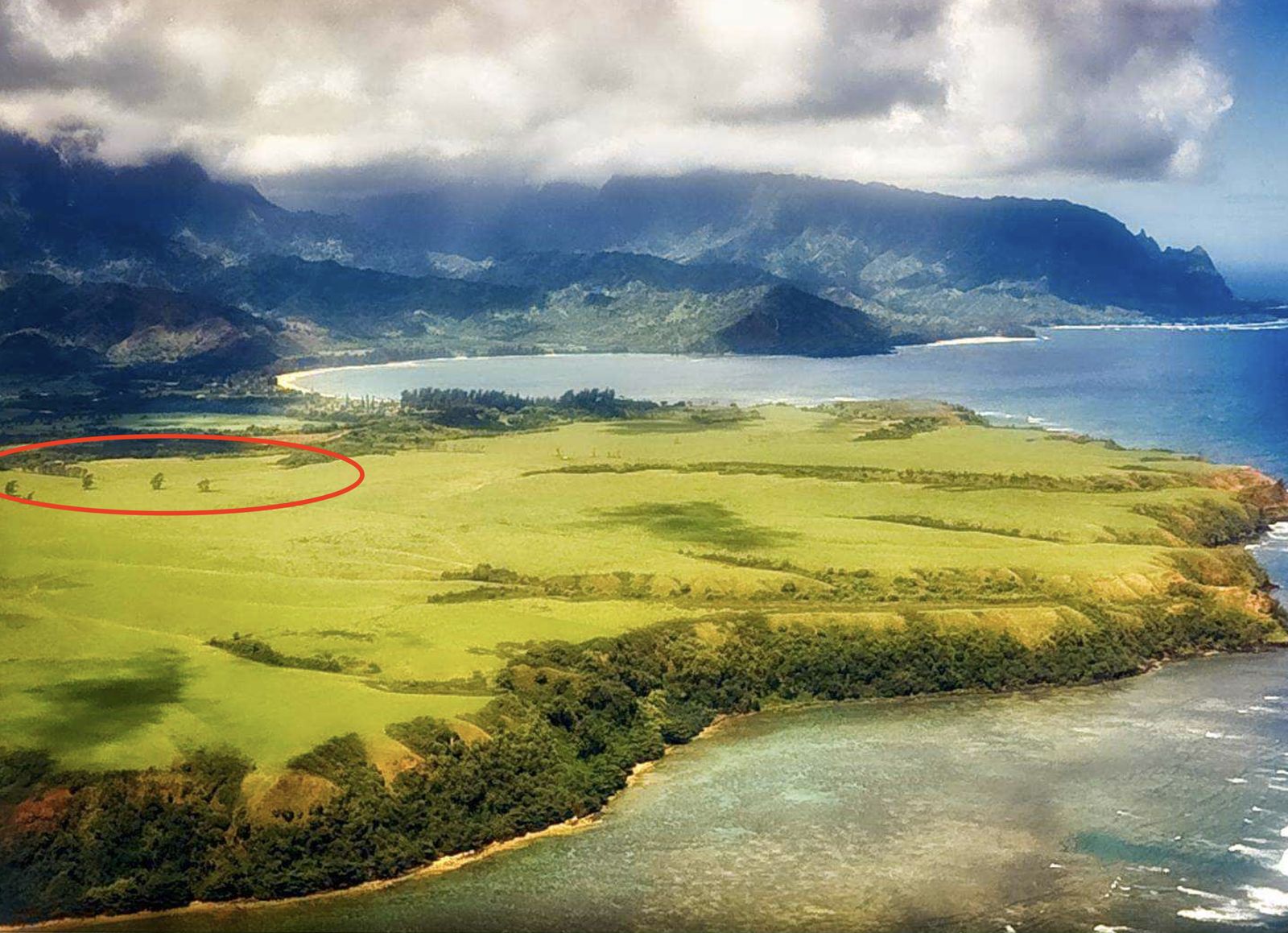
Princeville about 1970, before the golf courses were built. Circled: lone trees in the open pasture, in the general area where the Woods Course was later built. The 1975 offering statement said the cattle burial sites were “marked with planting of silver oak trees.”
1917–1919
The outbreakAn anthrax outbreak on the Princeville Ranch, “which includes the area that is now the Woods Course,” began in April 1917 and lasted until March 1919. Between 300 and 500 head of cattle died, according to multiple witnesses, along with an unknown number of horses and mules. Most carcasses were buried and covered with quicklime.
“Impossible to burn bodies, dying too quickly. Am burying and liming.”Telegram from Hanalei signed “Glaisyer,” April 13, 1917
1975
Buyers were told, in writingThe Public Offering Statement for Emmalani Subdivision said: “Within Emmalani Subdivision, there exist cattle burial sites which are thought to date back to the 1917 bovine anthrax epidemic. The sites were marked with planting of silver oak trees.”
Built around the graves
The golf course avoided themWhen Robert Trent Jones Jr. designed the Woods Course, the developer’s chief engineer, Curly Carswell, cautioned him against digging where the silver oaks grow “to avoid unearthing the anthrax-infested graves.” Jones testified that he designed the course to avoid any digging near those trees.
1979
The State said: leave them undisturbedCommenting on a golf course permit, the Department of Health wrote that burial sites of cattle afflicted by anthrax, marked by silver oak trees, “shall be left undisturbed during grading or land clearing operations.”
2020
Starwood was warnedAn August 2020 email to Starwood’s Jason Cruce, relaying a meeting with Robert Trent Jones Jr., said the silver oaks “remain and should not be touched,” and warned: “Anthrax is still potentially dangerous if dug up; stay away from the area.” Starwood’s own December 2020 cultural study, prepared for its glamping permit, recorded the same history.
2021
Two neighbors went to courtLorraine Mull and Frances White sued Starwood’s golf company to stop a glamping project on the Woods. That August, the court later found, Starwood stopped operating the Woods as a golf course.
2024–2025
What Starwood’s testing foundStarwood’s consultants took 188 soil samples from the Woods Course in fall 2024. The court found that 14 were “suspect,” meaning they “had positive results for at least some of the B. anthracis markers”; that ground-penetrating radar found 38 sites “consistent with grave sites”; and that Starwood’s own experts “could not say anthrax is not in the soil.” It found Starwood’s testing witnesses “not credible.”
2025
The court’s findingAfter a trial in June 2025, the court found that “there are anthrax burial sites on the Woods Course.” Its judgment bars a residential housing development on the course, and any “ground-disturbing activity, without appropriate testing, oversight, and court approval.”
2026
Starwood fights onStarwood has appealed, and has asked the Hawaiʻi Supreme Court to take the case. In May 2026 a judge declined its request to approve ground-disturbing work under a “safety plan,” while making clear that mowing, basic landscaping and maintenance are allowed.
Why digging is the danger
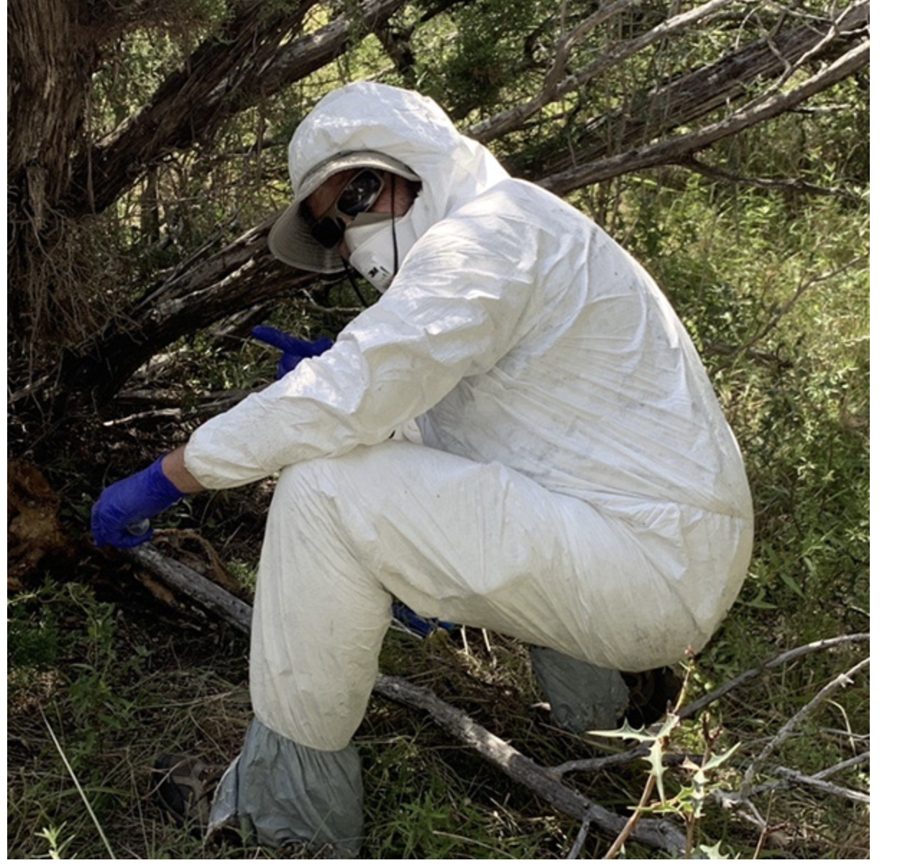
Anthrax field work is done in full protective gear. Photo: University of Florida News, from a 2024 story on Dr. Blackburn’s anthrax research (source). The story does not identify the person or the place.
Anthrax spores can persist in soil “for decades, even hundreds of years,” the court found, and lime, like the quicklime used in 1917, helps protect them. Experts on both sides agreed on that.
Spores come back up when the ground is disturbed. The World Organisation for Animal Health says they are “brought to the surface by wet weather, or by deep tilling.” On the Woods, Starwood’s own ground-penetrating radar found 38 sites “consistent with grave sites,” and its experts “could not say anthrax is not in the soil.”
Testing has limits. In Siberia, more than 200,000 soil samples taken in the decade before a deadly 2016 outbreak had all come back clean. Clean results did not prevent it. That is why the experts’ advice is simple: leave the ground alone.
When old anthrax graves are disturbed
Around the world, old anthrax burial grounds have come back to life when the ground was dug, flooded or thawed. Here is what happened, as officials and scientists reported it.
Sweden · 2011
Digging opened a forgotten grave
Ditch-digging on a nature-reserve pasture near Örebro exposed an unknown anthrax grave from the 1940s. About twenty cattle died. Spores were carried by the ditch water into a canal, where an animal downstream drank and died. The site was sealed under clay and a meter of soil, and nearby farms had to vaccinate their animals for years.
Nine cattle, a sheep, a horse and three moose died around Omberg, an area with several old anthrax graves. About 3,000 animals were vaccinated and about 30 people were given preventive antibiotics. Sweden’s agriculture minister told Parliament that with many old and sometimes unknown graves in the country, it could happen again.
After these outbreaks, Sweden searched its archives and mapped 3,160 farms that had been quarantined for anthrax between 1916 and 1961, so that building and excavation would not set off new outbreaks. Its veterinary institute’s advice: if you know exactly where a grave is, avoid digging there.
In July 2025, two villages in northern Kazakhstan were quarantined after people caught skin anthrax. Officials traced it to “a previously unidentified anthrax burial site” near a pasture. Infected cattle were destroyed, movement in and out was restricted, everyone exposed was given antibiotics, and the burial site was fenced and sealed in concrete. Eight people were confirmed infected; none died.
Near the capital, Astana, more than 500 houses were built inside the 1,000-meter protective zone around a 1986 anthrax burial site, whose recorded danger period runs to 2086. Soil tests there have been negative, and no one has fallen ill. Even so, officials have now banned all construction within a kilometer.
In an unusually warm, very dry summer, thawing ground in Russia’s Arctic released anthrax from old reindeer carcasses. About 2,350 reindeer died, 36 people were infected, and a 12-year-old boy from a reindeer-herding family died after eating infected reindeer meat. Herders were evacuated by helicopter, and military troops were sent in to decontaminate the area. In the decade before, more than 200,000 soil samples there had all tested clean.
In 2011, anthrax killed dozens of hippos along Zambia’s Luangwa River, and hundreds of people fell ill after eating or handling the meat. In 2023 the World Health Organization reported 684 suspected human cases and four deaths in Zambia, spreading along its river basins. In 2025, anthrax killed about 50 hippos in Congo’s Virunga National Park. With their bodies floating in the Ishasha River and Lake Edward, residents were warned to “boil water from local sources before drinking.”
Most of those places were farms, pastures, tundra and game reserves. Princeville is not. In 1975, the State-registered offering statement placed the burial sites “within Emmalani Subdivision,” among the homes. Today the Woods is surrounded by houses, with families, children, pets, elders, wildlife and our watershed all around it. That is why it must never be dug up.
What about water?
Anthrax spores can travel with soil and water. The CDC says animals can be infected when they breathe in, eat or drink spores in contaminated soil, plants or water. In Sweden in 2011, spores from a disturbed grave were carried by ditch water into a canal, where an animal downstream drank and died. In Australia’s Hunter Valley, investigators believed floods had unearthed the spores behind a 2007 outbreak that killed 53 cattle.
No health agency has documented anthrax getting into a town’s drinking water, and we do not claim it has. The lesson is simpler: once burial sites are disturbed, spores can move with the soil and the water, and cleaning up is slow and costly.
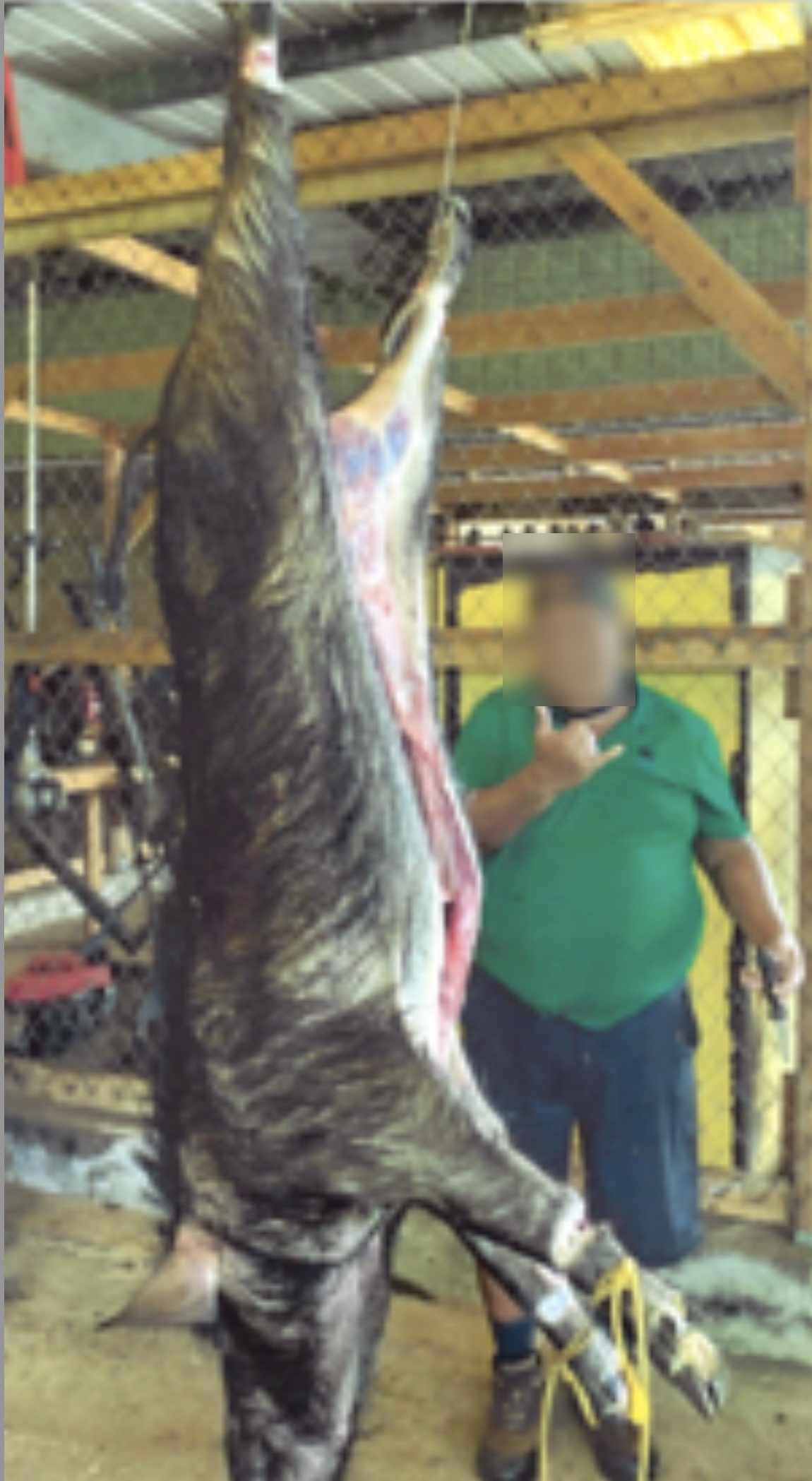
A feral hog hung for butchering. Feral pigs root through the soil across Kauaʻi, and their meat is eaten.
Most people who catch anthrax get it from infected animals or their meat. In Siberia in 2016, the 12-year-old boy who died had eaten infected reindeer meat. In Thailand in 2025, meat from a cow slaughtered at a village event and shared among neighbors was linked to four cases, including one death.
Feral pigs live across Kauaʻi and spend much of their time rooting in the soil. Pigs rarely get sick from anthrax. But when Colorado State University researchers tested blood from 478 feral pigs in Texas, they found anthrax antibodies, a sign the pigs had been exposed to spores in the ground, and suggested using pigs as an early warning that anthrax is present. Digging up the graves would bring spores to the surface where pigs and other animals root, and from animals, anthrax can reach people.
Court and historical sources: Mull & White v. SOF-XI Kauai PV Golf, Fifth Circuit Court, 5CCV-21-0000063, Findings of Fact and Conclusions of Law (July 14, 2025) ¶¶84–85, 89–91, 93, 100, 119, 128, 130, 132–133, 190; The Hawaiian Forester and Agriculturist (June 1917); Emmalani Subdivision Public Offering Statement, Reg. No. S-540 (1975, amended 1976), §8(d); Department of Health comments of June 25, 1979, quoted in the State Land Use Commission staff report on SP80-349 (Dec. 9, 1980); trial testimony of Jason Cruce (June 25, 2025); Ka Paʻakai O Ka ʻÄina Analysis prepared for SOF-XI Kauai PV Golf (Dec. 2020), p. 75; Department of Health email of May 14, 2026, filed with Starwood’s motion of July 6, 2026.